MEDWAY AIRCRAFT PRESERVATION SOCIETY Ltd
We restore and preserve historic aircraft and artefacts for public display.
Patron: Her Majesty The Queen
Short S.25 Sunderland

The Short Sunderland was the must successful of the Short Brothers' flying boats designed for the RAF and initially built at the Seaplane Works in Rochester, with 750 eventually constructed for the RAF in support of the war effort, where they operated mainly in a coastal command and transport role. A significant number flew with other allied air forces in similar roles. Powered by four Bristol Pegasus engines, they could fly for up to 13 hours at a cruising speed of 155 knots, generally flying at relatively low altitudes. Defence was provided by Browning machine guns and up to 2000 lb of bombs depth charges could be carried. Some were later rebuilt for civil use and termed 'Sandringham's'. MAPSL has undertaken several projects related to this ionic aircraft.
Short Sunderland G-BJHS
When a Short Sandringham flying boat, converted from a military Short Sunderland, came to the River Medway in 1984 at the invitation of Rochester-upon-Medway Council, it spent the next few years housed at Chatham Historical Dockyard. MAPSL Members, particularly Albert Lock and Bob Woollett, both of whom were experienced aircraft engineers and then around 70 became involved in the restoration and maintenance of this wonderful flying boat. Thus the initial desire of MAPSL, in its former guise as the Aircraft Preservation Group of the Medway Branch RAeS to undertake the restoration of a Sunderland partly came to fruition.
The flying boat started life as Sunderland Mk III ML614 in 1944, but was upgraded to a Mk V the following year, seeing service with 201, 422 and 330 Squadrons before being laid up in 1946. It later served for ten years with the Royal New Zealand Air Force as NZ4108. Its purchase by Ansett Airlines and conversion to a commercial airliner took place in 1963 to replace another converted Sunderland that had been damaged beyond repair during a gale on Lord Howe Island. It was subsequently bought by Captain Charles Blair for Antilles Airlines in the Caribbean, but little used. After Captain Blair’s death in a flying accident in the late 1970’s, it was sold by his widow, Maureen O’Hara to Edward Hulton. It was flown to the UK in 1981, based at Calshott and registered G-BJHS. While it remained at the dockyard, it was given the name “Sir Arthur Gouge” in honour of Short’s Chief Designer. However, owner Edward Hulton eventually decided to fly the aircraft to Florida in 1988 and it was lost from its place of conception and the company’s former base.
The images below show Albert (left) and Bob (right), either side of G-BJHS flying over Rochester.


Short Sunderland Auxiliary Power Unit
An Auxiliary Power Unit, generally referred to as an APU, was fitted in the leading edge of the starboard wing of a Short Sunderland Flying Boat. It had a 2-cylinder, 3½ HP petrol engine which powered a 12 V generator that was used to start the inboard starboard engine of the aircraft. An APU was required because turning an aircraft engine over during starting using a ground-based electrical supply is impractical for a flying boat. It also contained a pump to empty water from the bilges in the aircraft’s hull. The engine of the APU was started by means of a pull cord. It was also unusual as the engine had two connecting rods per piston instead of one, claimed to increase the reliability. A second APU was sited near the galley to provide power for cooking.
This particular engine was one of about 20 found in a wood yard near Biddenden under a pile of shavings. It was donated by the owner to MAPSL and was rebuilt by Mr Albert Lock, one of our former members. It was on loan to the Spitfire and Hurricane Memorial Building for an extended period, but is now in our Visitor Centre at Rochester Airport.


Gouge Flap
The Short S.26 “G-Class” flying boat G-AFCI “Golden Hind” was a real Rochester product, being designed there, constructed at the Seaplane Works and making its maiden flight from the River Medway on 21st July 1939. It was delivered to Imperial Airways for the empire flying routes. However, before it could enter service it was requisitioned by the Air Ministry in support of the war effort and spent much of its wartime career flying to Gibraltar, the Middle East and West Africa, transporting men, munitions and spare parts. It finally returned to the newly-formed BOAC, fulfilling its original purpose until it was retired in 1947, returning home and languishing in Rochester Harbour. In 1954, it ran aground at Harty Ferry on the Isle of Sheppey in a storm while being towed to an anchorage nearby and was eventually scrapped due to the damage to the hull. Various sub-assemblies were washed up on the shores of the Swale.
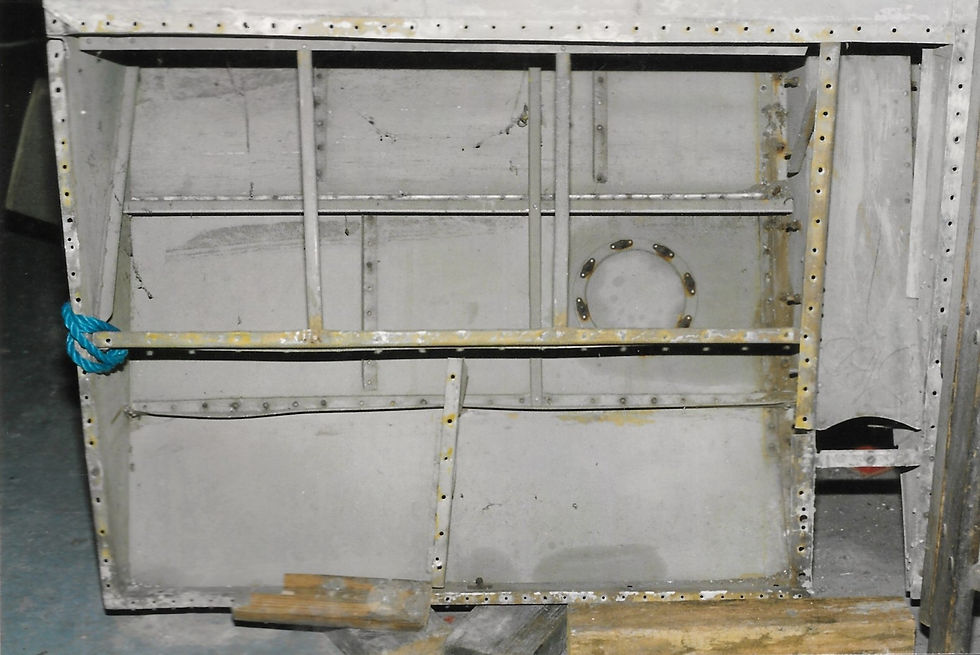
The Gouge flap was designed by Short’s Chief Designer for the G-Class flyng boats. One was mounted on the inboard trailing edge of each wing, and they could be extended and lowered to increase lift during slow-speed flight (take-off and landing) and retracted to form part of the normal wing profile at other times. The principle was first tried by fitting Short’s ‘hack’ Scion aeroplane with a modified wing and that demonstrated lower take-off and landing speeds and therefore that shorter runways could be used. Increasing lift at these times was considered essential for the larger flying boats then being developed, and the design was later included in the Sunderland.
This section was discovered many years later as forming a shed roof in a nearby allotment. Fortunately, the owner passed the item over to MAPSL where it was restored. On completion in July 2013, it was donated to ‘Muswell Manor’ which houses a small museum dedicated to the Short Brothers. Then-named ‘Mussel Manor’, it was beside the flying ground of the Aero Club and was where the Wright Brothers met the Short Brothers, to sign a contract to make six Wright Flyers under licence, building them in and adjacent field at the world’s first aircraft factory.